Vapor Pressure Deficit (VPD) is a measurement of the drying power of air and is widely used in greenhouses to optimize plant transpiration, nutrient uptake, and growth. Unlike relative humidity (RH), VPD considers both air temperature and humidity, making it a more accurate indicator of plant environmental conditions.
To calculate VPD, you need two measurements:
Air temperature (°C or °F)
Relative humidity (%RH)
Use a reliable environmental sensor placed near the plant canopy.
Recommended sensor locations:
At plant height
Away from direct airflow from fans
Away from heating/cooling equipment
In representative growing areas
Avoid placing sensors:
Near greenhouse walls
Near irrigation systems
Directly under ventilation outlets
The basic formula is:
VPD = Saturation Vapor Pressure (SVP) × (1 − RH/100)
Where:
SVP = maximum amount of water vapor air can hold at a given temperature
RH = relative humidity

Where:
T = air temperature in °C
SVP = kPa
Example:
Greenhouse conditions:
Temperature: 26°C
Relative humidity: 60%
At 26°C:
SVP ≈ 3.36 kPa
VPD:
3.36 × (1 − 0.60)= 1.34 kPa
This means the air has a moderate drying capacity suitable for many vegetative growth stages.
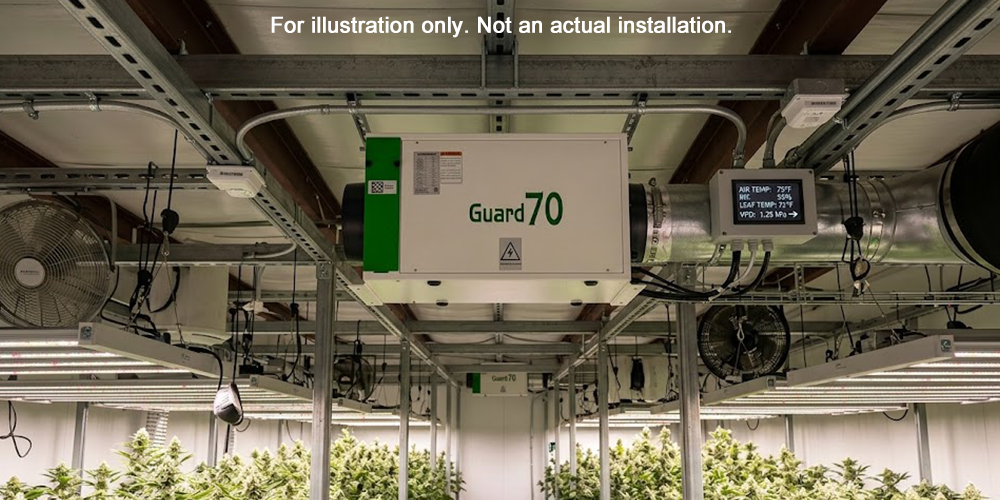
Instead of manual calculation, growers commonly use VPD sensors to measure Temperature, RH, and VPD automatically. Use smart greenhouse controllers can display real-time VPD, control dehumidifiers, adjust ventilation, control heating and cooling, and maintain target VPD ranges.
VPD targets depend on plant growth stage:
|
Growth Stage |
Temperature |
Target VPD |
|
Seedlings / clones |
22–26°C |
0.4–0.8 kPa |
|
Vegetative growth |
24–28°C |
0.8–1.2 kPa |
|
Flowering / fruiting |
24–28°C |
1.0–1.5 kPa |
|
Late flowering |
20–26°C |
1.2–1.6 kPa |
For many greenhouse crops, a VPD around 0.8–1.2 kPa is a common target during active growth.
A greenhouse often has high humidity because plants release water through transpiration. When RH becomes too high:
VPD decreases
Transpiration slows
Nutrient uptake declines
Mold and fungal risks increase
A greenhouse dehumidifier helps by:
Removing excess moisture
Increasing VPD to the optimal range
Reducing condensation on leaves
Improving disease prevention
Refrigerant dehumidifiers are commonly used when:
Temperature is above 18°C
RH is high
Large moisture removal is required
Desiccant dehumidifiers are preferred when:
Very low humidity is required
Greenhouse temperatures are low
VPD must be maintained during cold periods
A good greenhouse monitoring system includes:
Canopy-level temperature/RH sensor
VPD calculation software or controller
Dehumidifier with humidity control
Air circulation fans
Data logging system
For commercial greenhouses, multiple sensors are recommended because humidity can vary significantly between:
Upper canopy
Lower canopy
Near irrigation zones
Different greenhouse sections
To measure greenhouse VPD:
Measure temperature + relative humidity at canopy height
Calculate VPD using a formula or use a VPD sensor
Compare the value with the crop’s ideal range
Adjust humidity using ventilation, heating, or dehumidification
Maintaining the correct VPD helps plants achieve better transpiration, nutrient absorption, growth rate, and disease resistance.
 Hangzhou Hongtai Electrical Appliance Co., Ltd.
 info@seedmaxtech.com