Humidity control is one of the biggest challenges in indoor cultivation. Plants continuously release moisture through transpiration, and without proper dehumidification, excessive humidity can lead to mould, mildew, poor plant health, and reduced yields.
Although both refrigerant dehumidifiers and desiccant dehumidifiers can remove moisture, most grow rooms choose refrigerant dehumidifiers because they offer the best balance of energy efficiency, cost, moisture removal capacity, and operating convenience under typical cultivation conditions.
Refrigerant dehumidifiers work by cooling humid air below its dew point. Water vapour condenses on cold evaporator coils and is collected or drained away.
They perform best in environments with:
Temperature: 20–30°C (68–86°F)
Relative humidity: 50–70% RH
These conditions closely match many indoor cultivation environments.
Typical grow room conditions:
|
Growth Stage |
Temperature |
Relative Humidity |
|
Seedling stage |
22–28°C |
65–75% RH |
|
Vegetative stage |
22–30°C |
50–70% RH |
|
Flowering stage |
20–28°C |
40–55% RH |
Because most grow rooms maintain warm temperatures with grow lights and HVAC systems, refrigerant technology operates efficiently.
Energy consumption is a major operating cost for indoor farms.
A refrigerant dehumidifier uses a refrigeration cycle similar to an air conditioner:
Warm humid air enters the unit
The evaporator coil cools the air
Moisture condenses into water
The condenser reheats the dried air
Dry air returns to the grow room
This process removes moisture while recovering heat from the refrigeration cycle.
Advantages:
Lower electricity consumption
Lower operating costs
Higher moisture removal efficiency in warm environments
Less waste heat compared with many desiccant systems
For commercial growers running equipment 12–24 hours per day, energy savings can significantly affect profitability.
Cost is another major reason growers choose refrigerant dehumidifiers.
Compared with desiccant systems, refrigerant units typically have:
Lower purchase prices
Easier installation
Lower maintenance costs
More widely available replacement parts
For many small and medium-sized grow rooms, investing in a large desiccant system is unnecessary because a properly sized refrigerant unit can meet humidity requirements.
Modern commercial refrigerant dehumidifiers can remove large amounts of moisture.
Examples of applications:
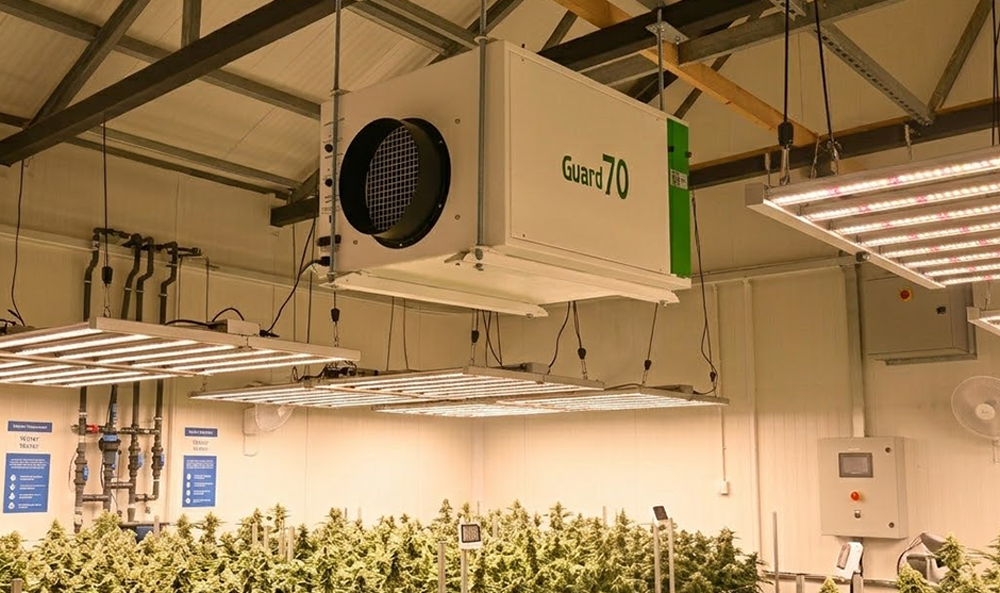
Indoor cannabis cultivation
Vertical farms
Hydroponic rooms
Greenhouses
Propagation rooms
High-capacity grow room dehumidifiers can remove hundreds of pints of water per day, making them suitable for large cultivation areas.
One of the biggest advantages for refrigerant dehumidifiers is the heat generated by lighting systems.
Traditional and high-intensity grow lights produce significant heat, raising room temperature and increasing evaporation.
Higher temperatures improve refrigerant dehumidifier performance because:
Air holds more moisture
More condensation occurs on coils
Compressor efficiency increases
LED lighting systems also generate heat, although generally less than older lighting technologies.
Desiccant dehumidifiers are excellent for achieving very low humidity levels, but most plants do not require ultra-dry conditions.
Typical cultivation targets are often:
Vegetative growth: 50–70% RH
Flowering: 40–55% RH
A refrigerant dehumidifier can usually maintain these ranges effectively.
Desiccant systems are more commonly used when growers need:
RH below 40%
Very low dew points
Cold-room operation
Laboratory-level humidity control
Most grow rooms use refrigerant dehumidifiers because they match typical cultivation conditions better than desiccant systems. They provide:
Efficient moisture removal in warm environments
Lower operating costs
Affordable installation
Reliable humidity control
For the majority of indoor farms and grow rooms, a properly sized commercial refrigerant dehumidifier is the most practical solution. Desiccant dehumidifiers remain a specialized option for growers who require extremely low humidity, cold-temperature operation, or advanced environmental control.
 Hangzhou Hongtai Electrical Appliance Co., Ltd.
 info@seedmaxtech.com

