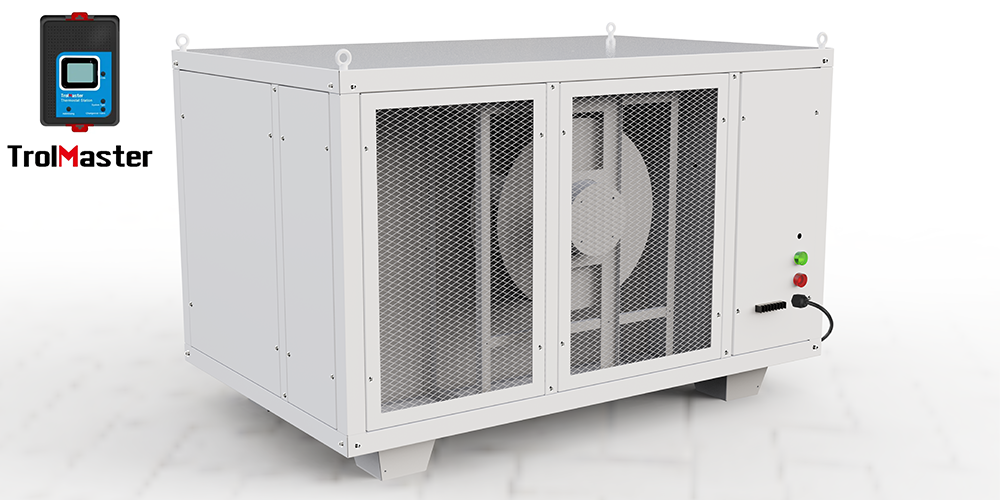
Choosing a commercial-grade grow room dehumidifier requires a more engineering-oriented approach than consumer units because commercial spaces have higher moisture loads, continuous operation, integration with HVAC controls, and serviceability requirements. Below is a structured process you can follow to select a proper unit for a commercial grow environment.
Grow Space Volume
Compute the room’s gross air volume:
Length × Width × Height = Cubic Feet (CF)
Commercial grow facilities can range from hundreds to tens of thousands of cubic feet — sizing scales non-linearly with volume.
Commercial facilities typically manage RH more tightly:
Vegetative: 55–70% RH
Flowering: 40–50% RH
Cloning/Propagation: 60–80% RH
Set your design setpoint based on your most stringent requirement (typically flowering) because your dehumidifier must maintain that reliably.
Commercial calculation is load-based, not just room size:
Sources of Moisture
Transpiration from plants (primary source)
Irrigation evaporation
Ventilation with outdoor air
Infiltration / leaks
Evaporative coolers or foggers
Plant Transpiration
Transpiration depends on:
Light intensity
Temperature
VPD (Vapor Pressure Deficit)
Plant species and density
Professional growers often estimate:
0.3–0.7 lbs of water per gallon of plant canopy per hour in full flower
You can also derive moisture load from:
Irrigation schedules
Air exchange rates
Latent heat load from HVAC design
Note: Commercial engineers typically use psychrometric analysis — load in lbs of water per hour (lb/hr) or kg/hr, not just pints/day.
Commercial dehumidifiers are sized in lb/day or kg/day moisture removal at specific conditions, or in HVAC terms latent capacity in BTU/hr.
Conversion reference:
1 pound of water ≈ 1 pint (US)
1 lb/hr moisture removal ≈ 24 pints/day
A commercial load might be tens or hundreds of pounds per day.
Compressor-Based (Refrigerant) Units
Best for warm and humid spaces
High capacity at typical grow temps (~70–85°F)
Can be packaged or modular
Use a professional greenhouse dehumidifier to remove moisture
Excel at low dew point and low temperature
Ideal when you need very low RH (<40%) or operate cooler
Commercial dehumidifiers should integrate with:
Building automation systems (BAS)
Environmental controllers (ECs)
HVAC latent and sensible loads
Fresh air ventilation and exhaust heat recovery
Control Features to Require
Analog/Digital I/O for external setpoints
Modbus / BACnet / other protocols
Remote humidistat probes (not at unit intake)
Continuous drain with proper plumbing
Alarms and fault reporting
Commercial installations rarely rely on a single unit:
N+1 redundancy: one extra unit beyond required capacity
Staged units: modulate capacity to meet variable loads
Load sharing across rooms or zones
This ensures uptime and fewer crop interruptions.
Capacity alone is not enough; you also need effective airflow:
Dehumidifier CFM must cycle room air 6–12×/hr (typical guideline)
Ensure no dead spots – often use ducted return/airwash configuration
Commercial units need:
Easy access to filters, coils, and blowers
Serviceable parts
Local technical support
Diagnostic interfaces
Ease of maintenance reduces downtime and cost.
Room: 30' × 50' × 12' → 18,000 CF
Plants: Full flower, high transpiration
Ventilation: 20% outside air
Irrigation evap load: significant
Engineer calculates:
Moisture load = 15 lb/hr (360 pints/day)
Choose unit(s) with capacity > 360 pints/day at design conditions
Control integration: Tie into BAS with remote sensors
 Hangzhou Hongtai Electrical Appliance Co., Ltd.
 info@seedmaxtech.com