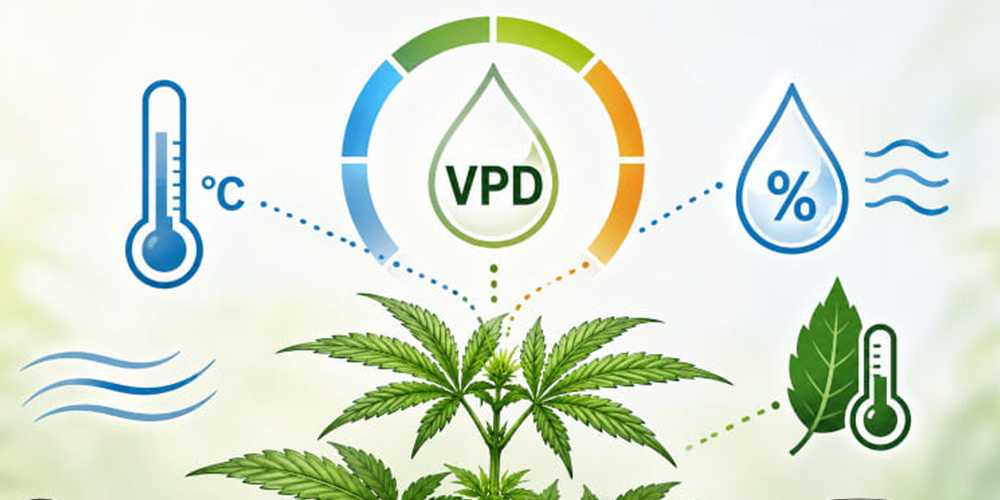
For plant cultivation, VPD is generally more useful than relative humidity (RH) because it accounts for both temperature and moisture in the air. However, RH remains an important parameter for controlling the growing environment.
VPD is usually the better metric for optimizing plant growth, while RH is essential for managing the room.
|
Factor |
Relative Humidity (RH) |
VPD |
|
Measures |
Moisture level relative to saturation |
Vapor-pressure difference between leaf and air |
|
Considers temperature |
Indirectly |
Yes |
|
Indicates transpiration potential |
Limited |
Yes |
|
Useful for dehumidifier control |
Yes |
Indirectly |
|
Useful for irrigation decisions |
Limited |
Yes |
|
Useful for managing plant stress |
Limited |
Yes |
|
Mold/condensation management |
Very useful |
Less direct |
Plants lose water primarily through transpiration. The driving force behind this process is strongly related to the vapor-pressure difference between the leaf and surrounding air.
RH alone can be misleading because it doesn't fully describe how dry or humid the air is from the plant's perspective.
For example, 60% RH at 20°C is very different from 60% RH at 30°C. The air has different vapor-pressure characteristics at those temperatures, so the plant's transpiration environment is also different.
VPD incorporates temperature, making it a more useful indicator of the plant's actual evaporative environment.
A low VPD generally means the air is very humid relative to the leaf.
This can result in:
Reduced transpiration
Slower nutrient transport
Poorer calcium movement
Excessively wet growing media
Greater risk of condensation
Increased risk of fungal and microbial problems
This is why maintaining an appropriate VPD is particularly important in dense canopies and during flowering.
A high VPD means the air has a strong drying capacity.
Potential effects include:
Excessive transpiration
Water stress
Leaf curling or wilting
Stomatal closure
Reduced photosynthetic performance
Increased irrigation demand
Therefore, higher VPD isn't necessarily better. The objective is to maintain a VPD appropriate for the plant species and growth stage.
For practical environmental control, use both.
A good approach is:
For example, a grow-room controller might use an RH setpoint to operate a dehumidifier while the grower monitors VPD to determine whether the resulting environment is appropriate for the plants.
RH tells you how humid the room is. VPD tells you how strongly the environment is driving plant transpiration.
VPD is more important for optimizing plant growth and transpiration, but RH is more important for directly controlling the room's moisture level. The best cultivation strategy uses both rather than treating them as alternatives.
Prev:none
 Hangzhou Hongtai Electrical Appliance Co., Ltd.
 info@seedmaxtech.com