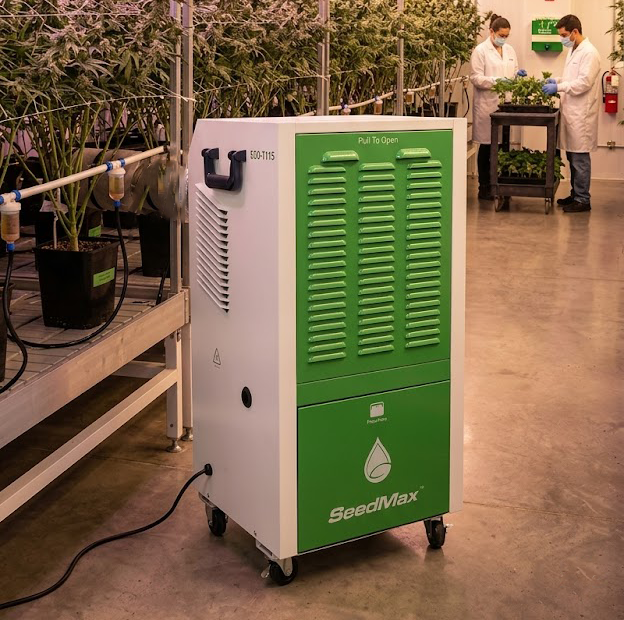
Choosing the right dehumidifier size for a commercial cannabis grow is critical for preventing mold, improving plant health, and maintaining stable vapor pressure deficit (VPD). An undersized unit may struggle to control humidity, while an oversized system can waste energy and over-dry the room.
Cannabis plants release large amounts of moisture through transpiration. In commercial cultivation facilities, thousands of plants can add hundreds of gallons of water vapor to the air every day. Without proper dehumidification, growers may experience powdery mildew, bud rot, condensation on walls or ceilings, poor flower quality, reduced yields, and HVAC overload.
Larger rooms naturally require more moisture removal capacity. Key measurements include room square footage, ceiling height, total cubic volume. However, plant density matters more than room size alone.
The moisture load mainly comes from plant transpiration.
A mature cannabis plant may transpire: 0.5–1+ gallons of water per day
Large commercial grows can release hundreds of gallons daily.
Humidity requirements change throughout cultivation.
Vegetative Stage
Recommended humidity: 55%–70% RH
Plants transpire less during this stage.
Flowering Stage
Recommended humidity: 40%–50% RH
Flowering plants produce heavier moisture loads and face higher mold risks.
Lighting affects plant transpiration and room temperature.
High-Intensity Lights
HPS systems generate more heat
Higher temperatures increase transpiration
LED Systems
Produce less heat
Can still create significant humidity loads due to dense canopies
Hydroponics and frequent irrigation increase moisture evaporation. Higher humidity loads are common in deep water culture, aeroponics, and flood-and-drain systems.
Your HVAC system also influences dehumidification needs. Sealed grow rooms often require dedicated grow room dehumidifiers, and integrated HVACD systems. Facilities using outside air ventilation may need additional capacity during humid weather.
1.Small Commercial Grow Rooms (500–1,000 sq ft)
Typical requirement: 100–300 pints/day (PPD)
Suitable for:
Small licensed cultivation rooms
Propagation rooms
2.Medium Commercial Facilities (1,000–5,000 sq ft)
Typical requirement: 300–1,500 PPD
Usually requires:
Multiple commercial units
Ducted dehumidification systems
3.Large Commercial Cultivation Facilities (5,000+ sq ft)
Typical requirement: 1,500–10,000+ PPD
Often uses:
Industrial dehumidification systems
Integrated environmental controls
Centralized HVACD systems
A common estimate of a dehumidifier for weed tent is that can remove approximately 5–10 gallons of water per 1,000 watts of grow lighting per day. Another industry guideline: size dehumidification capacity close to total daily irrigation/transpiration volume.
Example Calculation:
Suppose a flowering room has 100 mature plants
Each plant releases 0.75 gallons/day
Daily moisture load: 100 \times 0.75 = 75
That equals: 75 gallons/day (≈ 600 pints/day)
In this case, the room may require:
One large commercial grow room dehumidifier, or several smaller units combined.
RH stays above target range
Condensation appears during lights-off periods
Mold or mildew develops
Dehumidifier runs continuously
Slow humidity recovery after irrigation
Excessively low humidity
Plants show stress from dry air
Frequent short cycling
Unnecessary energy costs
Standalone commercial dehumidifiers are best for smaller grow operations, retrofit projects, and zone-specific humidity control.
Integrated HVACD systems are best for large commercial facilities, sealed rooms, and precision environmental control.
Integrated systems can coordinate cooling, heating, dehumidification, ventilation, and CO enrichment.
The right commercial cannabis grow dehumidifier size depends on plant count, transpiration rate, lighting, irrigation, and environmental control strategy. Many commercial growers size systems based on daily water removal requirements rather than room size alone. Proper sizing helps stabilize humidity, improve flower quality, reduce disease risk, and increase overall cultivation efficiency.
 Hangzhou Hongtai Electrical Appliance Co., Ltd.
 info@seedmaxtech.com