Vapor Pressure Deficit (VPD) is the difference between the amount of moisture the air can hold when saturated and the amount of moisture actually present. It is a critical parameter in greenhouse management because it directly affects plant transpiration, nutrient uptake, and growth.
To measure VPD accurately, you need:
An air temperature sensor
A relative humidity (RH) sensor
(Recommended) A leaf temperature sensor or infrared thermometer
A VPD calculator or greenhouse climate control software
Place a temperature sensor at the plant canopy level, away from direct sunlight and irrigation spray.
Example:
Air Temperature = 25°C (77°F)
Use a calibrated hygrometer or environmental sensor near the crop canopy.
Example:
Relative Humidity = 60%
Plant leaves are often 1–3°C cooler than the surrounding air due to transpiration.
Example:
Leaf Temperature = 24°C
Using leaf temperature provides a more accurate VPD value because plants respond to conditions at the leaf surface.
The simplified formula is:
VPD = Saturation Vapor Pressure × (1 − RH/100)
Where saturation vapor pressure depends on temperature.
For example:
Air Temperature = 25°C
RH = 60%
The resulting VPD is approximately 1.27 kPa.
For greater accuracy, many growers use digital VPD calculators or climate control systems that automatically calculate VPD from temperature and humidity readings.
|
Crop |
Recommended VPD |
|
Tomatoes |
0.8–1.2 kPa |
|
Cucumbers |
0.6–1.0 kPa |
|
Peppers |
0.8–1.2 kPa |
|
Lettuce |
0.5–0.8 kPa |
|
Growth Stage |
Recommended VPD |
|
Clone/Seedling |
0.4–0.8 kPa |
|
Vegetative |
0.8–1.2 kPa |
|
Early Flower |
1.0–1.3 kPa |
|
Late Flower |
1.2–1.6 kPa |
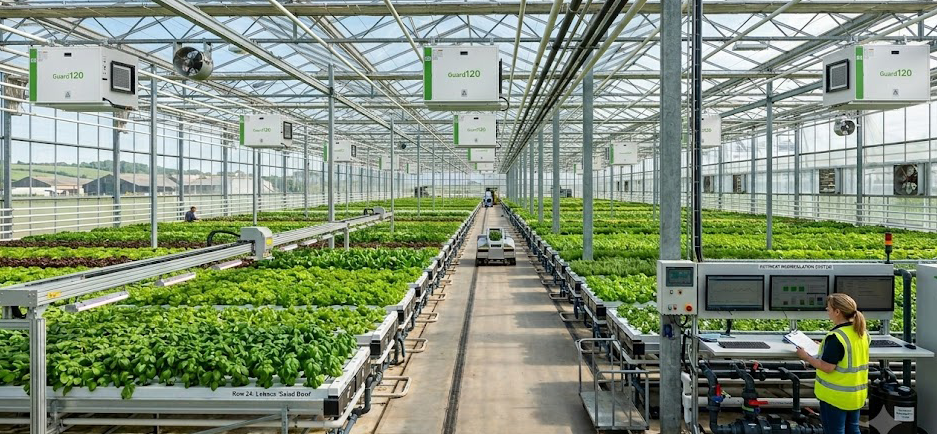
Many commercial greenhouse systems continuously monitor temperature, relative humidity, leaf temperature, and CO₂ concentration.
These systems automatically adjust grow room dehumidifiers, ventilation fans, heating systems, cooling pads, and misting systems to maintain the target VPD range.
Reduced transpiration
Slow nutrient uptake
Increased disease risk
Condensation on leaves
Excessive water loss
Plant stress
Leaf curling
Reduced growth and yield
Measure temperature and humidity at canopy level using calibrated sensors and monitor VPD continuously throughout the day. For most greenhouse crops, maintaining a VPD between 0.8 and 1.2 kPa provides a good balance between transpiration and plant health, though the optimal range depends on the crop and growth stage.
 Hangzhou Hongtai Electrical Appliance Co., Ltd.
 info@seedmaxtech.com