Modern indoor agriculture—including vertical farms, grow rooms, greenhouses, and controlled-environment agriculture (CEA)—requires precise humidity management. Plants continuously release water vapor through transpiration, while irrigation, hydroponic systems, and nutrient solutions add additional moisture to the growing environment. Without adequate dehumidification, excessive humidity can lead to condensation, plant diseases, poor crop quality, and inefficient HVAC operation.
Humidity control is not simply about keeping RH low. The objective is to maintain the right balance between relative humidity (RH), temperature, and vapor pressure deficit (VPD).
Excessive humidity can cause:
Condensation on leaves, ceilings, and equipment
Fungal and bacterial diseases
Reduced transpiration
Poor nutrient and calcium transport
Mold growth
Corrosion of electrical equipment
Increased cooling loads
Unstable growing conditions
A well-designed dehumidification system removes moisture generated by plants and irrigation while maintaining the desired temperature and VPD.
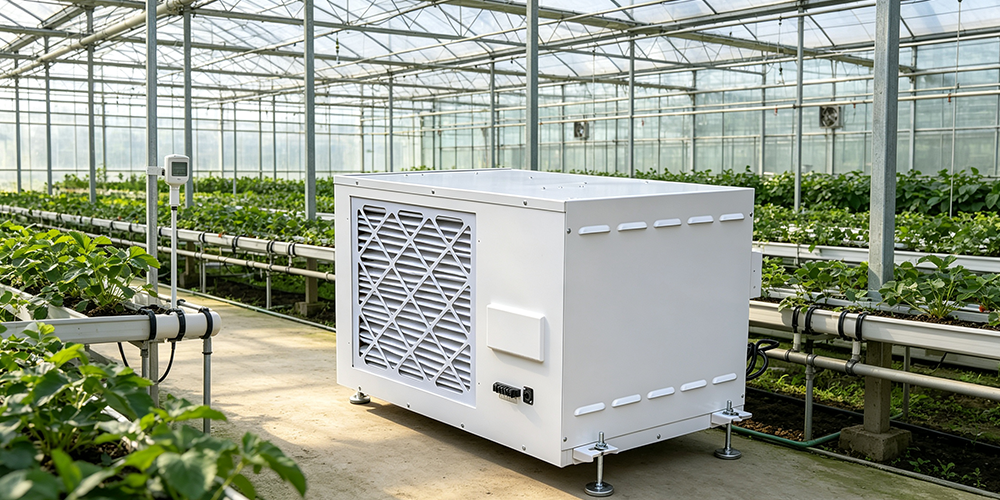
A typical system includes industrial dehumidifiers, HVAC equipment, air circulation fans, sensors, and a control system.
The process generally works as follows:
Plant transpiration → moisture enters the air → humidity sensors detect RH → dehumidifier removes moisture → dry air is returned to the growing space → controller maintains the target RH/VPD
The system may operate independently or be integrated with the facility's HVAC system and environmental control platform.
Refrigerant dehumidifiers are widely used in indoor grow rooms because they can efficiently remove large quantities of moisture while operating at typical cultivation temperatures. They are particularly suitable for moderate-to-high humidity conditions.
Desiccant dehumidifiers use an adsorbent material to remove moisture and can achieve very low humidity levels. They are more suitable for applications requiring extremely low RH or precise low-dew-point conditions.
For many commercial grow rooms, a high-capacity refrigerant dehumidifier provides a practical balance between moisture-removal performance, energy consumption, and installation cost.
Plant transpiration is usually the most important moisture load in an indoor agricultural facility. However, equipment sizing should consider the entire moisture balance.
Important factors include:
Growing area
Plant type and growth stage
Number and density of plants
Irrigation method
Daily irrigation volume
Lighting and heat load
Indoor temperature
Target RH or VPD
Outdoor air infiltration
Door-opening frequency
HVAC capacity
Building envelope
For a commercial facility, dehumidifier capacity should be calculated from the expected peak moisture generation, rather than simply using floor area.
Plants do not transpire at the same rate throughout their lifecycle.
During early growth, the moisture load may be relatively low. As plants develop a larger canopy, transpiration increases significantly. During flowering or fruit production, environmental control can become particularly important.
This means a modern indoor farm should ideally use automatic humidity control rather than operating the dehumidifier at a fixed schedule.
Modern indoor agriculture increasingly uses integrated environmental control systems.
Temperature and RH sensors can continuously calculate VPD and adjust dehumidification, cooling, heating, and ventilation accordingly.
A more advanced system can coordinate:
Temperature + RH + VPD + CO₂ + lighting + irrigation + HVAC + dehumidification
This provides more stable growing conditions while reducing unnecessary energy consumption.
Dehumidifiers do not simply remove water; refrigerant dehumidifiers also reject heat into the growing environment.
Therefore, the dehumidification system should be coordinated with the cooling system. If a large dehumidifier operates continuously in a grow room without sufficient heat removal, room temperature may rise.
In commercial facilities, integrating dehumidification and HVAC can improve overall energy efficiency and environmental stability.
A modern indoor agriculture dehumidification system should be designed around the facility's moisture load, crop transpiration, temperature, RH, VPD, and HVAC strategy.
For many indoor farms and grow rooms, high-capacity refrigerant dehumidifiers are an effective solution for managing substantial plant-generated moisture. Desiccant systems become more attractive when very low dew points or extremely tight humidity control are required.
The best system is not simply the dehumidifier with the largest capacity. It is a properly sized and intelligently controlled system that works together with HVAC, airflow, irrigation, and environmental controls to create a stable growing environment.
 Hangzhou Hongtai Electrical Appliance Co., Ltd.
 info@seedmaxtech.com

