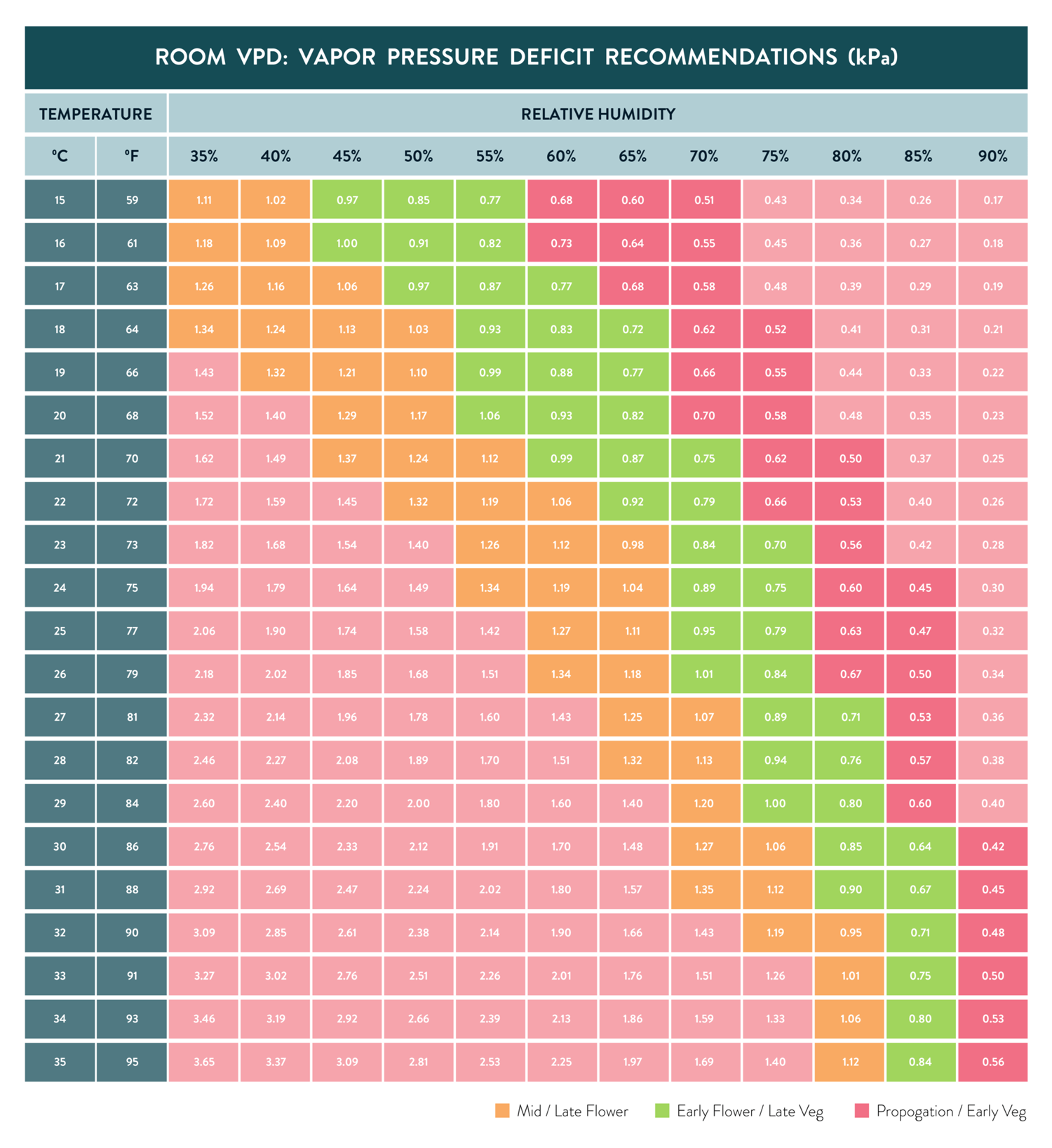
Vapor Pressure Deficit (VPD) is an important environmental parameter in plant cultivation. It describes the difference between the amount of moisture the air currently holds and the amount it could hold when fully saturated at a given temperature.
In simple terms, high VPD means the air has a strong drying effect on plants. When VPD becomes too high, plants can lose water through transpiration faster than their roots can replace it.
Understanding what causes high VPD can help growers maintain a more stable environment and avoid excessive plant stress.
VPD is primarily influenced by air temperature and relative humidity (RH).
High VPD generally occurs when:
Air temperature is too high
Relative humidity is too low
The combination of high temperature and low RH creates a large moisture deficit
For example, air at 30°C and 40% RH has a much higher VPD than air at 25°C and 60% RH.
This is why controlling only humidity may not be enough. A grow room can have an RH level that appears acceptable while still having excessive VPD because the temperature is too high.
Temperature is one of the most important factors affecting VPD.
As temperature increases, the saturation vapor pressure of air increases. If relative humidity does not increase accordingly, the difference between saturation vapor pressure and actual vapor pressure becomes larger.
This means that high temperatures can quickly push VPD upward.
For indoor cultivation, high temperatures can result from:
Excessive grow light heat
Insufficient HVAC capacity
Poor air circulation
Inadequate heat removal
High outdoor temperatures
Excessive equipment heat
If the grow room becomes hotter while RH remains unchanged, VPD will increase.
Low RH means the air contains relatively little water vapor compared with the amount it could hold at the current temperature.
When RH drops, VPD rises.
For example, if temperature remains constant:
60% RH → moderate VPD
40% RH → higher VPD
30% RH → very high VPD
This relationship is particularly important during the vegetative and flowering stages of indoor cultivation, when growers often target specific VPD ranges.
Ventilation can also contribute to high VPD.
If dry outdoor air is introduced into a grow room at a high rate, it can lower indoor RH. If temperature remains elevated, the resulting VPD can become excessive.
This is especially relevant in dry climates or during periods when outdoor air has a low absolute moisture content.
Ventilation is useful for removing heat and replenishing CO₂, but it should be balanced with humidity control.
If a grow room has high temperatures and insufficient moisture input, RH can fall below the desired level.
This may happen when:
Plants are small and transpire relatively little.
Ventilation is high.
HVAC systems continuously remove moisture.
Outdoor air is dry.
A humidifier is undersized.
The room has excessive air exchange.
Adding a properly controlled humidification system can help reduce VPD when the environment is too dry.
Air-conditioning systems naturally remove some moisture as they cool air.
In a grow room, an oversized HVAC system may lower temperature quickly but also remove more moisture than necessary. If humidity drops significantly while plant temperature remains high, VPD can rise.
This is one reason environmental control systems should be designed around both temperature and humidity, rather than temperature alone.
VPD is closely related to transpiration.
When VPD is high, the vapor pressure difference between the leaf and surrounding air increases. This can increase the plant's transpiration demand.
Moderately elevated VPD may encourage active transpiration, but excessively high VPD can create water stress.
Potential symptoms include:
Leaf edges curling or drying
Wilting
Rapid water consumption
Reduced stomatal conductance
Nutrient transport problems
Reduced photosynthetic performance
Slower growth
Leaf damage under severe conditions
Plant response depends on species, growth stage, root-zone conditions, light intensity, airflow, and other environmental factors.
Understanding the opposite condition is also useful.
High VPD
High temperature + low RH → high VPD
The atmosphere has a strong capacity to pull water from plant leaves.
Low VPD
Low temperature + high RH → low VPD
The air is closer to saturation, so the drying force is weaker.
Extremely low VPD can reduce transpiration and increase the risk of excessive moisture around leaves, particularly when airflow is poor.
The goal is generally not to maximize or minimize VPD, but to maintain a plant-appropriate VPD range.
If your grow room VPD is too high, you can generally lower it by reducing temperature, increasing humidity, or doing both.
Check:
Grow light heat
HVAC performance
Air circulation
Heat generated by equipment
Room insulation
Reducing excessive temperature can directly lower VPD.
Depending on the growing environment, you may use:
Humidifiers
Reduced ventilation
Improved environmental control
Water management
Automated RH control
However, increasing RH too aggressively can create a different problem. Excessive humidity can increase condensation and disease risk.
For commercial grow rooms and controlled-environment agriculture, integrating temperature and RH sensors with HVAC, humidification, and dehumidification equipment can provide much more stable VPD control.
A properly designed system can respond automatically when temperature or humidity moves outside the desired range.
No.
High VPD is not automatically harmful. Plants require transpiration, and an appropriate VPD can support water and nutrient movement and healthy growth.
The problem occurs when VPD becomes excessive for the plant's species or growth stage.
Different plants and growth stages have different environmental requirements, so growers should avoid treating a single VPD value as universally ideal.
Dehumidifiers are especially important when VPD needs to be managed in environments where humidity tends to become excessive.
During periods of high plant transpiration, plants can release substantial amounts of water vapor into the grow room. Without adequate moisture removal, RH can rise and VPD can fall.
A refrigerant dehumidifier is commonly used in many indoor growing environments because it can efficiently remove moisture while operating within typical grow-room temperature ranges.
For large commercial cultivation facilities, dehumidification may be integrated with HVAC systems and automated environmental controls.
High VPD is primarily caused by high temperature, low relative humidity, or a combination of both.
Because VPD depends on temperature as well as RH, monitoring humidity alone does not provide a complete picture of the plant environment.
If VPD is consistently too high, evaluate temperature, RH, ventilation, HVAC operation, humidification, and plant transpiration. The goal should be to maintain a stable environment appropriate for the crop and growth stage—not simply to push VPD as low or as high as possible.
Prev:none
 Hangzhou Hongtai Electrical Appliance Co., Ltd.
 info@seedmaxtech.com